
Table of Contents
If you have spent any real time sitting at a desk, you already know the small but maddening moment when your chair refuses to roll smoothly anymore, and an office chair wheels replacement is usually the fix you are looking for.
Maybe it squeaks every time you shift your weight. Maybe one wheel has cracked and the chair tilts slightly to one side. Maybe it has simply stopped rolling altogether and now drags across the floor like it is anchored down.
None of this means your chair is finished. In almost every case, the actual problem is isolated to the wheels, and an office chair wheels replacement is one of the simplest, cheapest, and most satisfying repairs you can do yourself.
Most people finish an office chair wheels replacement in under twenty minutes, often without needing a single tool.
This guide walks through everything you need to know before, during, and after an office chair wheels replacement. We will cover why wheels fail, how to figure out exactly what type of wheel your chair needs, and the difference between hard and soft casters.
We will also cover how to actually remove and install new wheels, and what an office chair wheels replacement typically costs.
We will show you how to stop your new wheels from scratching your floor the way the old ones may have. Whether you are fixing one home office chair or managing seating for an entire office floor, this is the only guide you should need.
Why Office Chair Wheels Wear Out or Break
Office chair wheels are one of the most heavily used moving parts in your entire workspace, and yet they are often the cheapest, flimsiest component on the chair.
Every time you roll back from your desk, stand up, or spin slightly to reach something, you are putting load and friction directly through those small plastic or rubber wheels.
Over months and years, that adds up. It is exactly why an office chair wheels replacement eventually becomes necessary even on a chair you otherwise like.
There are a few common reasons wheels fail. The most obvious is simple wear and tear. Cheap chairs, especially budget workstation chairs bought in bulk for offices, often come with low-grade plastic casters that were never built to handle years of daily rolling.
The outer rim cracks, the axle pin bends, or the wheel simply stops spinning freely and starts dragging. Once that happens, an office chair wheels replacement is usually the fastest fix.
Dust, hair, and debris are another major culprit, particularly with carpeted offices. Carpet fibers and hair wind themselves tightly around the wheel axle over time, eventually jamming the wheel so it cannot rotate.
This is why a wheel that once rolled silently can start squeaking or grinding without actually being broken at all. It might just be clogged, not damaged.
Weight is a factor too. Office chair wheels are rated for specific load capacities, and a chair used by someone heavier than that rating, or a heavy executive model with a solid frame, puts extra stress on the wheels with every movement.
This accelerates cracking, especially in cheaper nylon or polypropylene wheels.
Finally, floor type plays a bigger role than most people realize. Hard floors like tile, marble, or hardwood are tougher on standard hard plastic casters than carpet is, because there is no give in the surface to absorb shock.
If your office chair has been rolling on a hard floor with the wrong type of wheel, you may be looking at both a wheel problem and a floor protection problem at the same time. We will get into fixing both later in this guide.
How to Tell If You Actually Need an Office Chair Wheels Replacement
Before pulling anything apart, it helps to correctly diagnose the issue, because not every rolling problem actually calls for an office chair wheels replacement. Here is how to narrow it down.
If your chair makes a grinding or squeaking noise but still rolls, the issue is very likely dirt, hair, or dried lubricant inside the wheel housing rather than a structural failure. This is the cheapest possible fix.
A thorough cleaning with a flathead tool to remove tangled debris, followed by a drop of silicone-based lubricant, often solves the noise without spending a rupee on parts or attempting a full office chair wheels replacement.
If one or more wheels visibly wobble, lean to one side, or look physically cracked around the rim, that wheel has likely reached the end of its life. At that point, a straightforward office chair wheels replacement is the right move.
You do not necessarily need to replace all five wheels if only one or two are damaged, although matching sets do roll more evenly.
If the entire chair feels unstable or tips slightly, check whether a wheel has come loose from its socket rather than failed completely. Sometimes the stem has simply worked its way out and just needs a firm push back in.
If your chair refuses to roll at all and instead drags across the floor, this is often caused by a wheel that has frozen solid. At this point, an office chair wheels replacement is almost always faster and cheaper than trying to repair the wheel itself.
Understanding Office Chair Wheel Types Before You Buy
This is the step most people skip, and it is the reason so many replacement attempts fail. Office chairs do not all use the same wheel size, stem type, or wheel material.
Buying the wrong type means the new wheels either will not fit your chair base at all, or will fit poorly and fall out within days. Before ordering anything for your office chair wheels replacement, you need to understand three separate things: the stem type, the wheel diameter, and the wheel material.
Stem Type: The Part That Actually Plugs Into Your Chair
The stem is the small post sticking out of the top of the wheel that inserts into the chair’s base socket. Almost all modern office chairs use one of two stem styles.
The most common is a grooved stem, which has a small ridge or groove cut into it that locks into a matching ring inside the chair base socket. This is sometimes called a snap-in stem and is the standard fitting for the vast majority of office, workstation, and gaming chairs sold today.
The second type is a friction-fit stem, slightly different in diameter and used more often on older or specific furniture lines. It relies purely on a tight press fit rather than a locking groove.
Stem diameter typically falls into a few standard sizes, most commonly 10mm, 11mm, and occasionally 7mm or 8mm on lighter chairs. The safest way to get this right before any office chair wheels replacement is to remove one of your existing wheels and either measure the stem with a ruler or bring it along, physically or as a photo, when buying replacements.
Wheel Diameter
Office chair wheels usually range between 50mm and 75mm in diameter, with 50mm being the standard size found on most mid-range workstation and executive chairs.
Larger wheels generally roll more smoothly and handle uneven flooring better, which is why some premium ergonomic chairs use 60mm to 75mm wheels.
Hard Wheels vs Soft Wheels: The Decision That Matters Most
This is the single most important choice in any office chair wheels replacement, and it depends entirely on your flooring, not your chair.
Hard wheels, usually made of solid nylon or polypropylene plastic, are designed specifically for soft flooring like carpet. The hard surface of the wheel needs the slight resistance of carpet fiber to roll properly.
On a hard floor, these wheels roll too freely, offer very little control, and will scratch or scuff the surface over time.
Soft wheels, made from polyurethane or rubber with a softer outer coating, are designed for hard flooring such as tile, marble, hardwood, laminate, or vinyl. The soft outer layer grips the hard surface gently and rolls smoothly without skating uncontrollably.
Most importantly, soft wheels do not damage the floor finish the way a hard plastic wheel does.
The rule is simple and worth repeating because it trips up most buyers planning an office chair wheels replacement: hard floor needs soft wheels, and soft floor, meaning carpet, needs hard wheels.
If you have ever wondered why your chair scratches your hardwood floor even though the wheels “look fine,” this mismatch is almost certainly the reason, regardless of whether the wheels are old or brand new.
Tools You Will Need
The good news about an office chair wheels replacement is that it requires almost no specialized tools. In most cases, you need nothing more than your own hands and a flat, stable surface to work on.
For a small number of stuck or seized wheels, a flathead screwdriver or a pair of pliers can help with leverage. If you are cleaning out debris before installing new wheels anyway, a pair of small scissors or a seam ripper makes quick work of tangled hair and carpet fiber wound around the axle.
Step-by-Step: How to Replace Office Chair Wheels
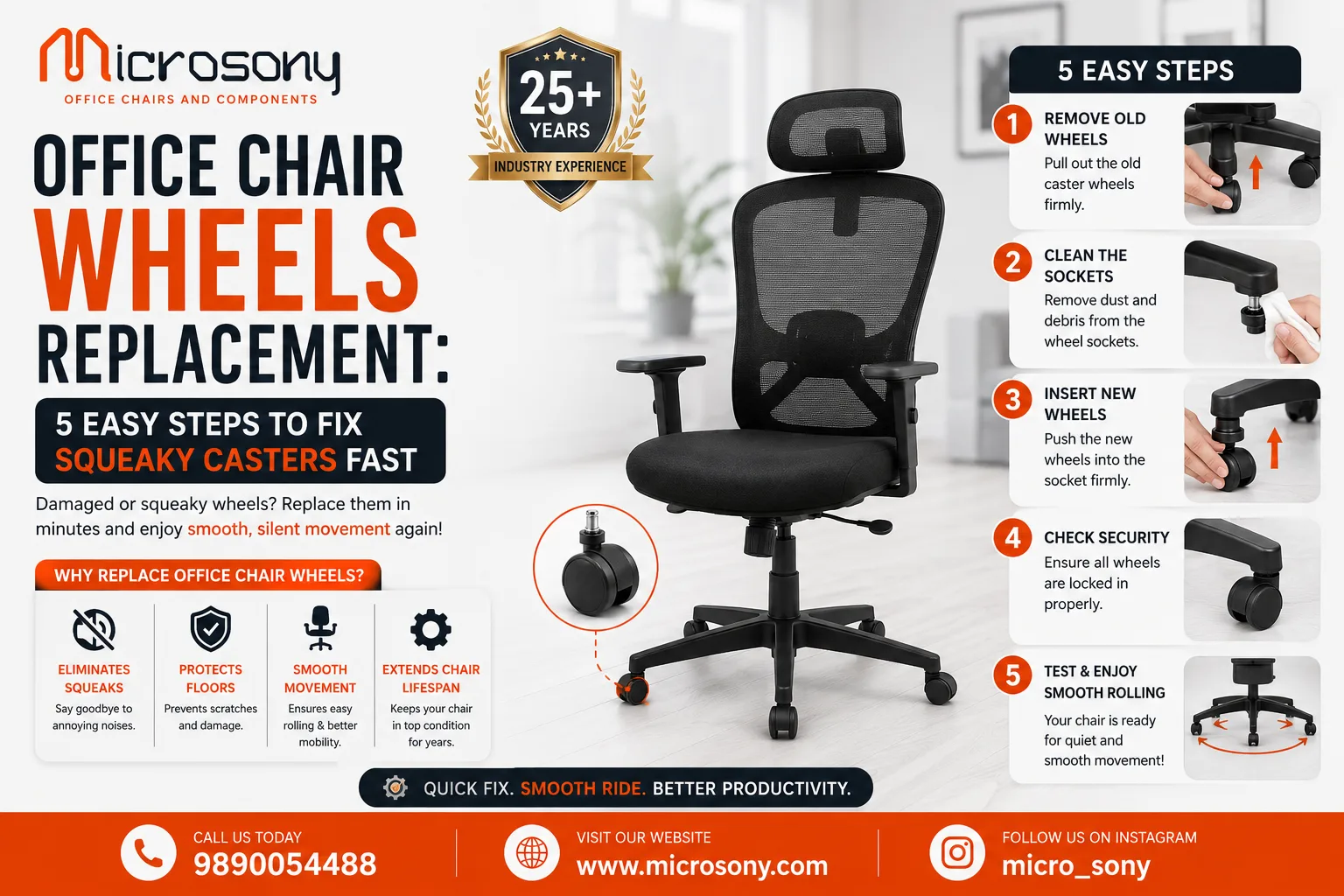
Step 1: Tip the Chair and Get Clear Access to the Base
Lay the chair on its side or tip it backward so the underside of the base, where the five wheels are mounted, is facing up and fully accessible.
Working on a table or raised surface can make this easier on your back and gives you better visibility than crouching on the floor.
Step 2: Remove the Old Wheel
For a standard grooved stem wheel, removal is usually just a matter of pulling firmly and steadily straight down on the wheel, away from the base. The internal groove will release with a bit of resistance, similar to unplugging a tightly seated cable.
If the wheel does not budge by hand, wedge a flathead screwdriver between the top of the wheel housing and the underside of the chair base, then gently pry while pulling.
Avoid excessive force or twisting, which can crack the plastic socket inside the chair base itself. That is an issue that is far more expensive to fix than the wheel was in the first place.
Step 3: Clean Out the Socket
Before inserting a new wheel, take a moment to clean any dust, broken plastic fragments, or hair out of the empty socket in the chair base.
A dirty or debris-filled socket is one of the most common reasons a brand-new wheel does not seat properly and falls out again within days of an otherwise correct office chair wheels replacement.
Step 4: Insert the New Wheel
Line up the stem of the new wheel with the empty socket and push it straight in with firm, even pressure until you feel or hear a slight click. That click indicates the internal groove has locked into place.
Give the wheel a gentle tug after inserting it to confirm it is securely seated and will not pop out under normal use.
Step 5: Repeat for Each Wheel and Test
Repeat the process for every wheel you are replacing. If you are only replacing one or two damaged wheels rather than the full set, that is perfectly fine functionally, though some people prefer a matching look across all five.
Once all new wheels are installed, flip the chair back onto its base and roll it across the floor in a few directions. Check that all wheels spin freely, sit at an even height, and do not wobble.
How Much Does an Office Chair Wheels Replacement Cost?
One of the best things about this particular repair is how inexpensive it is relative to buying an entirely new chair. A set of five replacement office chair wheels typically costs a modest amount.
Pricing generally depends on three factors: whether the wheels are hard or soft type, the diameter, and the build quality or brand. Premium soft-wheel sets designed specifically for hardwood and tile floors tend to sit at the higher end of the range because of the rubber or polyurethane coating.
Standard hard plastic wheels for carpeted offices are usually the most affordable option. For context, an office chair wheels replacement almost always costs a small fraction of what a single new mid-range office chair would cost.
That makes it one of the best value repairs available for extending the working life of a chair you already own and are otherwise happy with.
For businesses managing seating across an entire office, buying replacement wheel sets in bulk is also significantly more economical than replacing whole chairs on a rolling basis. This is especially true when the rest of the chair, including the frame, mechanism, and cushioning, is still in good working condition.
How to Protect Your Floors After Replacing Office Chair Wheels
Even with the correct soft wheels installed for a hard floor, a few extra habits go a long way in protecting your flooring investment over time.
Using a chair mat underneath your desk setup adds an additional cushioned layer between the wheels and the floor finish, particularly useful in high-traffic home offices or shared workstations.
Periodically wiping down the wheels themselves removes grit and small debris that can otherwise act like sandpaper against polished or laminated surfaces.
If you notice any single wheel rolling less smoothly than the others even shortly after an office chair wheels replacement, check it for trapped debris before assuming it is defective. This is a far more common cause of early “wheel failure” than an actual manufacturing fault.
When to Replace the Whole Chair Base Instead of Just the Wheels
In rare cases, the problem is not the wheels themselves but the sockets they sit in. If you notice that new wheels consistently fall out of one particular socket regardless of how firmly you press them in, the internal locking mechanism inside that part of the chair base may be worn out or cracked.
At that point, an office chair base replacement, sometimes called a star base replacement, addresses the root issue rather than repeatedly attempting an office chair wheels replacement on a socket that has nowhere secure to hold a wheel.
This is still considerably cheaper than buying an entirely new chair, since the base is a separate, replaceable component on most standard office and executive chair designs.
How to Choose Quality Replacement Wheels (Not Just Cheap Ones)
Once you know your stem type, wheel diameter, and whether you need hard or soft casters, there is still a quality decision to make. It is worth not defaulting straight to the cheapest option on the page for your office chair wheels replacement.
A handful of practical signs separate a wheel that will last for years from one that will crack again within months.
Check the load rating first. Reputable replacement wheel sets list a maximum weight capacity, and this should comfortably exceed the heaviest person likely to use the chair, not just match their weight exactly. Industry body BIFMA publishes the standard load and durability tests most quality office chair components are rated against.
A wheel rated close to the limit will wear out faster under daily use than one with genuine headroom.
Look at the axle construction next. Wheels with a metal axle pin running through the center of the roller tend to hold up far better over time than wheels where the axle is molded entirely from plastic.
The metal pin resists the bending and stress that eventually cracks an all-plastic design. This is usually visible in product photos or listed in the description.
Consider the roller material itself. Dual-wheel casters, where each caster is actually two smaller wheels mounted side by side rather than one single roller, tend to roll more smoothly and distribute weight better than single-roller designs.
This matters most on uneven flooring or thicker carpet.
Finally, buy from a supplier that specializes in chair components rather than a generic seller. Dedicated component suppliers are far more likely to stock genuine sizing information, consistent stem diameters, and wheels actually tested for the load and floor conditions they claim to handle.
This matters even more for offices managing dozens or hundreds of chairs, where a batch of poorly made wheels means repeating an office chair wheels replacement across every workstation within a year.
Replacing Wheels Across Multiple Office Chairs (Bulk Considerations)
If you are responsible for facilities or admin decisions across an office, school, hospital, or co-working space rather than a single home desk, an office chair wheels replacement becomes a slightly different kind of project. Doing this at scale changes a few things worth planning for in advance.
First, audit before you order. Not every chair in a fleet will need the same wheel type, especially in mixed environments with both carpeted cabins and tiled or marble common areas.
Sorting chairs by floor zone before ordering prevents the common and costly mistake of buying one large batch of hard wheels, only to discover that half the office sits on hard flooring and now needs an entirely separate soft-wheel order.
Second, standardize stem type where possible. If your office has accumulated chairs from different brands and purchase cycles over the years, as most growing companies eventually do, you may be dealing with two or three different stem sizes across your seating.
Identifying this upfront, rather than discovering it one chair at a time, saves significant back-and-forth with suppliers and avoids partial orders that do not fit.
Third, factor in labor time if an in-house team will be doing the office chair wheels replacement rather than a vendor. Each wheel typically takes well under a minute to swap once you have the technique down.
Even a fleet of fifty chairs translates to a few hours of total work rather than a multi-day project, making this one of the more efficient facilities fixes available compared to reupholstering or replacing chairs outright.
For bulk office, institutional, or retailer requirements, working directly with a manufacturer or component specialist rather than a retail marketplace listing usually means better pricing per unit and more consistent stem and wheel sizing across the full order.
Frequently Asked Questions About Office Chair Wheels Replacement
Are office chair wheels universal?
Most modern office chairs use a standard grooved stem that fits a wide range of universal replacement wheels, which is why “universal” wheel sets are so common and widely sold.
However, stem diameter and wheel size can vary slightly between chair brands and models, so it is always worth checking measurements rather than assuming any universal set will fit perfectly.
Can I mix hard and soft wheels on the same chair?
While it is mechanically possible, it is not recommended. Mismatched wheel types roll differently and can cause the chair to feel unstable or tilt slightly during movement.
It is best to replace all five wheels with the same type when switching wheel categories during an office chair wheels replacement.
Why do my new office chair wheels still scratch the floor?
This almost always means you have installed hard wheels on a hard floor, which is the most common mistake in any office chair wheels replacement.
Double check that your new wheels are specifically rated for hardwood, tile, or laminate flooring rather than the standard carpet-style hard wheel.
How long do replacement office chair wheels typically last?
With normal daily office use, quality replacement wheels generally last several years before showing the kind of wear that requires another office chair wheels replacement. This varies based on user weight, floor type, and how often the chair is moved.
Do I need to replace all five wheels at once?
No. If only one or two wheels are damaged, you can replace just those, though many people choose to do all five at once simply for a uniform look and to avoid uneven rolling resistance between old and new wheels.
Final Thoughts
An office chair wheels replacement is, in almost every case, a fast, low-cost, and genuinely satisfying fix that can add years of useful life to a chair that is otherwise still comfortable and structurally sound.
The real work lies not in the physical swap itself, which takes only minutes, but in correctly identifying your stem type and wheel size. Most importantly, choose hard or soft wheels based on your actual floor type rather than guessing.
Get that part right, and your office chair wheels replacement will leave you with a chair that rolls smoothly, sits evenly, and stops damaging your floors, all without the cost or hassle of replacing the entire chair.
If you would rather skip the guesswork on sizing and compatibility, Microsony’s Chair Wheels range supplies genuine, tested replacement wheels and a full range of office chair components, including gas lifts, bases, mechanisms, and armrests, suited for both individual chairs and bulk office requirements across India.